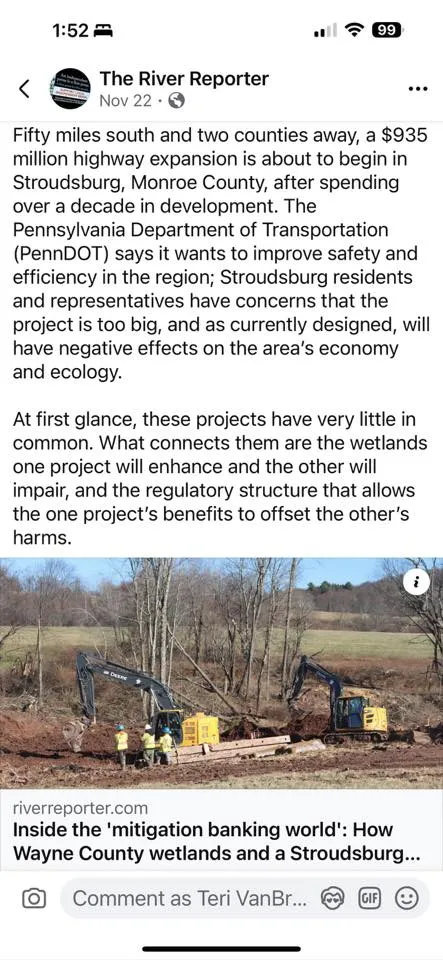
It’s late November, and a flock of construction-yellow excavators are chewing up the earth in a field in Damascus Township, Wayne County. They’re installing a stream and wetland complex that will improve the health and water quality of North Branch Calkins Creek, a stream that feeds into the Delaware River.
Fifty miles south and two counties away, a $935 million highway expansion is about to begin in Stroudsburg, Monroe County, after spending over a decade in development. The Pennsylvania Department of Transportation (PennDOT) says it wants to improve safety and efficiency in the region; Stroudsburg residents and representatives have concerns that the project is too big, and as currently designed, will have negative effects on the area’s economy and ecology.
At first glance, these projects have very little in common. What connects them are the wetlands one project will enhance and the other will impair, and the regulatory structure that allows the one project’s benefits to offset the other’s harms.
The highway project
PennDOT’s $935 million project will upgrade and expand I-80 along a 3.5 mile stretch which runs through Stroud Township and the boroughs of Stroudsburg and East Stroudsburg, Monroe County. Planned work includes the highway’s expansion from four lanes to six, as well as expanded shoulders.
The construction as planned runs through a patch of wetland in Stroudsburg Borough. (For more on wetlands, and their importance to the natural world, see sidebar.) According to an independent Wetlands and Waters Identification and Delineation Report prepared by Cherry Ridge Consulting LLC, the area includes a primary vernal pool (i.e., a pool that forms seasonally in the spring) with forested wetland at the edges.
Wetlands have a number of legal protections. In this case, to make up for the impact to wetlands from the I-80 project, PennDOT plans to offset it with the creation or preservation of wetlands elsewhere.
Ronald Young, a press officer with PennDOT District 5, told the River Reporter that, “For the I-80 reconstruction project, compensatory mitigation is required due to the impact to wetlands. To construct the project, some impacts to wetlands cannot be avoided, so as per environmental protection regulations, PennDOT will provide mitigation through substitute resources at the Sunnybrook Wetland Mitigation Bank.”
Hence, the yellow excavators in a dry, brown Wayne County field.